Time-Blocking a Study Week: A Visual Plan for Every Subject

A study plan works best when it is visible, realistic, and repeatable. Time-blocking is a visual planning method that gives every subject a fixed place in the week, so you do not have to decide what to study each time you sit down. It is a practical way to learn how to study well while protecting time for classes, work, rest, and ordinary life.
This guide explains how to time-block a realistic study week around classes, even when your schedule changes or your workload feels uneven. The aim is not to fill every minute. It is to create a calm structure you can follow, adjust, and reuse from week to week.
What time-blocking means for study
Time-blocking means assigning a specific subject or task to a specific period on your calendar. Instead of a vague list such as “study chemistry,” you reserve Tuesday from 4:00 to 5:15 for chemistry practice and Thursday from 6:30 to 7:15 for chemistry review. The block becomes a clear appointment with the work.
Each block should have a purpose. A useful study block usually contains one of three kinds of work: learning new material, practicing retrieval, or reviewing and consolidating. Naming the purpose makes the block easier to start and easier to evaluate afterward.
Start with the fixed parts of your week
Begin with the commitments you cannot move: classes, labs, commuting, work shifts, meals, sleep, and regular appointments. Place these first on a weekly grid. A paper planner, wall calendar, or digital calendar all work, provided you can see the whole week at once.
Next, mark the transitions around fixed commitments. Travel time, short breaks, and a buffer after a demanding class prevent the plan from becoming too tight. A schedule that ignores transitions is difficult to follow, even with good intentions.
Assign every subject a home
Look at each subject and decide where it will live during the week. Give it a recurring place rather than moving it around each time. For example, mathematics might have a longer practice block on Monday and a shorter review block on Thursday. Reading might appear twice for focused note review rather than once for a long, tiring session.
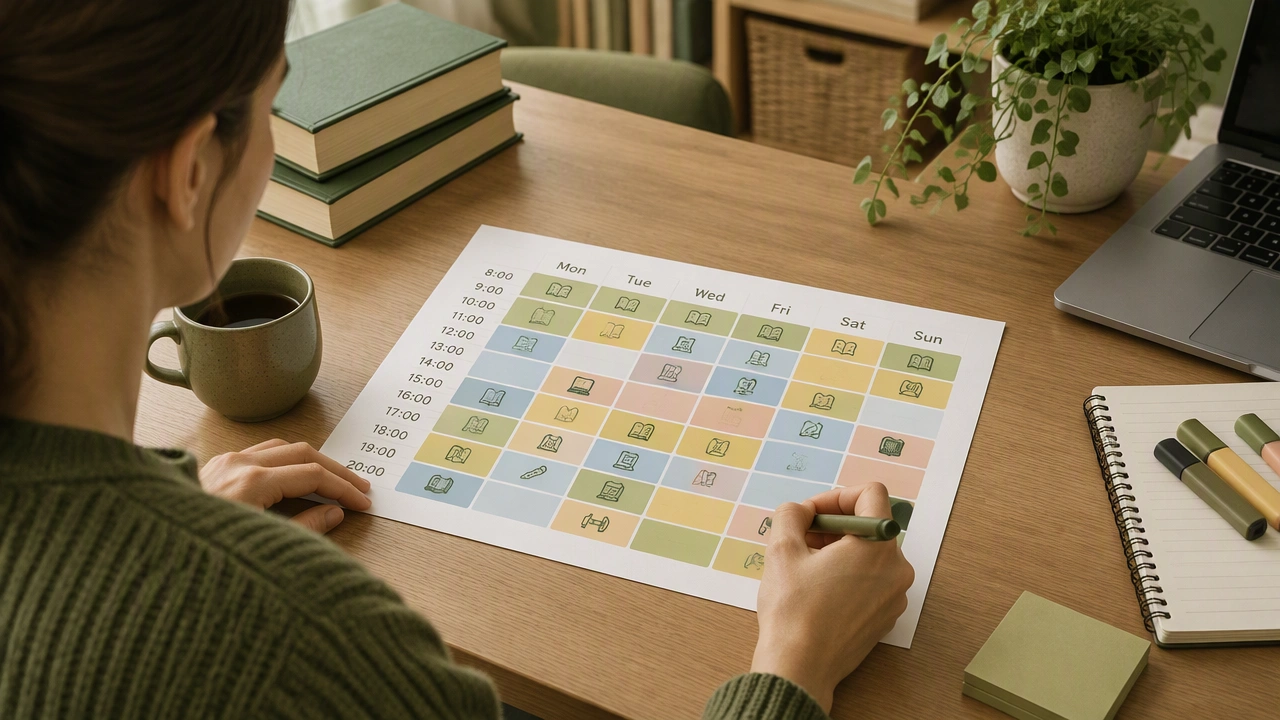
Use a simple visual system. One color per subject, a small symbol for the type of work, or a consistent position in the weekly grid can make the plan readable at a glance. Keep the system light enough that you can maintain it without decorating the page for hours.
Choose block lengths you can sustain
Start with blocks that match your real concentration. Forty-five to sixty minutes is a common starting point, but shorter blocks can be more useful when you are tired or learning difficult material. A block should be long enough to make progress and short enough to keep your attention steady.
Include short breaks between blocks. Five to ten minutes is often enough to reset your posture, drink water, and prepare for the next task. Avoid turning the break into a long distraction loop; decide in advance what you will do during it.
Build the week in four passes
Pass one: map constraints. Write down all fixed commitments and the hours you need for sleep, meals, and travel. This is the honest version of your week, not an idealized one.
Pass two: place core study blocks. Assign each subject at least one primary block. Put demanding subjects when your energy is usually higher, and place lighter review work where your attention is naturally lower.
Pass three: add flexible blocks. Leave one or two open blocks for unfinished work, unexpected assignments, or a subject that needs extra practice. Flexibility keeps the plan from collapsing when reality changes.
Pass four: review and adjust. At the end of the week, check which blocks you kept, which you moved, and which subjects received too little time. Use that evidence to shape the next plan.
Make each block easy to begin
Before a block starts, write a small action on the plan: “solve eight algebra problems,” “outline two pages,” or “quiz flashcards from Unit 3.” Specific actions reduce the friction of starting and make it easier to see when the block is complete.
Gather the materials you need in advance. Open the correct notes, place the textbook nearby, and remove obvious distractions. The first five minutes of a block should be about beginning, not searching for the right page.
Handle uneven workloads without overloading
Some weeks demand more time for one subject than another. When that happens, adjust the blocks instead of adding work on top of everything else. Move a flexible block, shorten a lower-priority review, or combine two short sessions into one focused period. Keep at least one recovery block in the week so the plan remains humane.
If a subject consistently needs more time, give it a larger recurring place in the following week. If another subject is going well, protect a smaller maintenance block rather than removing it completely.
Use a weekly review to keep the plan realistic
Set aside ten to fifteen minutes at the same time each week to review the schedule. Ask three questions: What worked? Where did I lose time? What does the next week require? Write the answers next to the calendar so the lessons stay visible.
The review is also the moment to check balance. A plan that is academically strong but leaves no room for rest will not last. Adjust block lengths, move sessions, and protect the fixed parts of your life before adding new study time.
Common mistakes to avoid
- Planning every minute. A crowded calendar looks productive but leaves no room for delay, questions, or recovery.
- Using vague labels. “Study history” is easier to avoid than “make a timeline of three causes and test recall.”
- Ignoring energy. Place difficult work where your attention is strongest, not only where the calendar has a gap.
- Skipping review. Recall and consolidation need their own blocks; reading alone is not a complete plan.
- Changing the system too often. Give a visual method several weeks before deciding whether it needs a redesign.
A simple template to try this week
Draw seven columns for the days of the week. List fixed commitments first. Then give each subject one primary block and one short review block where possible. Add a flexible block, a short break after each main session, and one weekly review appointment. Keep the plan in one place you will see every day.
At first, the schedule may feel imperfect. That is expected. The value of time-blocking comes from repetition: each week you learn more about your real energy, your actual workload, and the amount of focus you can sustain. Over time, the visual plan becomes a reliable habit, and each subject has a clear, familiar place in your week.